This massive Antarctic ice shelf will be gone in just a few years, NASA says
In 2002, scientists at NASA were tracking daily satellite images of Antarctica when they watched in astonishment as a huge chunk of the Larsen B Ice Shelf splintered and collapsed in just a month.
This was an area of ice the size of Rhode Island — 1,250 square miles — and it just disintegrated before their eyes:
Larsen-B ice shelf in Antarctica, seen on January 31, 2002 and February 17, 2002. (new study
finds that what's left of the Larsen B ice shelf — about 625 square
miles — is melting and fragmenting so quickly that it's likely to vanish
entirely by 2020 or so.
"This ice shelf has existed for at least 10,000 years, and soon it will be gone," said Ala Khazendar of NASA's Jet Propulsion Laboratory, who led the study. The video below gives an overview:
While Larsen B is a particularly dramatic case, it's not an isolated one. As the planet warms up,
a number of Antarctica's ice shelves have been melting dramatically in
recent decades — with serious consequences for rising sea levels around
the world.
Why collapsing ice shelves are a big deal
First, some terminology. Antarctica is covered by vast ice sheets that sit atop the continent. Many of these ice sheets flow, gradually, toward the ocean, where they form ice shelves that float on the water. Over time, chunks of these ice shelves break off — or "calve" — to form icebergs. These ice shelves essentially keep the ice sheets behind them
hemmed in — think of the shelves as a pie crust, preventing the filling
from leaking out:
(NASA)
For thousands of years, this system was roughly stable. Ice would
flow gradually into the oceans. But this was all counterbalanced by snow
that was falling back on top of Antarctica and replenishing the ice
sheets. Antarctica's ice shelves have thinned by up to 18% in the last 18 years
Over the last two decades, however, that's changed. As global warming has progressed, Antarctica's ice sheets are now losing 147 gigatons of ice each
year, mainly from the Amundsen Sea sector of West Antarctica. The
system is no longer in balance, and Antarctica's ice is flowing more
quickly into the ocean than before.
One reason for that? Those floating ice shelves that keep the land ice hemmed in have been thinning and at times collapsing. That's
partly because water beneath the shelves has gotten warmer, eating away
at the ice from below. Stronger winds have also pushed more of that
warm water into the shelves. A big 2015 study in Science estimated
that Antarctica's ice shelves have thinned by up to 18 percent in the
last two decades — mainly in West Antarctica but also around the bigger
East Antarctica region. Meanwhile, some shelves have been collapsing
entirely. Scientists watched the Larsen A Ice Shelf collapse in 1995.
Then the Larsen B Ice Shelf in 2002. Then the Wilkins Ice Shelf in 2008.
When ice shelves collapse, they don't immediately affect sea level
rise much, since their ice was already floating in the water anyway. But
the disintegration of these shelves allows the ice behind them to flow
more rapidly into the sea — and that does have the potential to significantly speed up sea level rise. After Larsen A and Larsen B collapsed, the glaciers behind them began losing ice into the sea 300 percent faster than before. Overall, studies have found that the loss of ice shelves has contributed to a 59 percent increase in ice discharge from regions of West Antarctica. That's all helping to push up global sea levels.
So how high will sea levels rise?
Coming for us. (Joe Raedle/Getty Images)
This is the big question — and the one most relevant to coastal cities around the world.
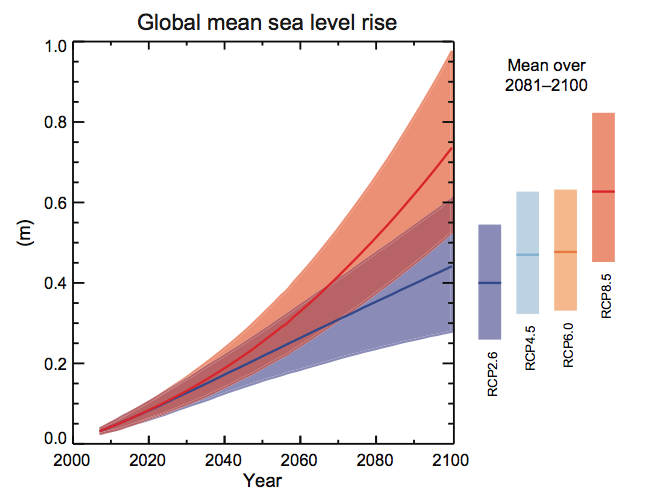
For now, the Intergovernmental Panel on Climate Change (IPCC) projects that global warming will cause worldwide sea levels to risebetween
1 foot and 3 feet, on average, by 2100. That's partly because ocean
water expands as it warms. But it's partly because more ice from
Antarctica, Greenland, and other glaciers is melting and flowing into
the oceans, pushing up sea levels:
(IPCC)
Yet some scientists have argued
that the IPCC's projections actually underestimated the possibility of
major ice loss from Antarctica. If so, it's possible that future
sea-level rise could be on the higher end of projections.
The ultimate amount of sea-level rise will depend partly on how much the Earth actually warms
in the coming decades, and partly on local conditions in Antarctica.
Increased snowfall in East Antarctica, for instance, could partially
counteract the increased loss of land ice.
Over the longer term, however, Antarctica has the capability of
raising sea levels much, much higher. West Antarctica's ice sheet
contains enough ice to raise sea levels worldwide by 10 to 14 feet, on
average. In 2014, two studies argued that a major portion of West
Antarctica's ice sheet has now been destabilized irreversibly,
and its slide into the sea over the next 200 to 900 years is all but
inevitable. The only real question is how fast it will go. Then there's the even more massive East Antarctica ice sheet,
which contains enough ice to raise global sea levels by another 190 feet
or so. Thankfully, this sheet appears far more stable, and it
would take many, many centuries for all that ice to melt. Yet if even a
fraction of that ice slid into the sea, it would alter coastlines and
cities dramatically for generations to come.
--------- Further reading:By the way, there's another aspect of Antarctica's climate that wasn't discussed above — namely, the floating sea ice that forms in the ocean around the continent during the winter.
This sea ice has actually been expanding to record highs of late, even as the planet has warmed, and scientists are still debating why.
It's a fascinating story. But it's also not very relevant to global sea
levels, since this ice was already floating in the sea. When it comes
to sea-level rise, it's land ice that matters most — and Antarctica is losing its land ice, on net.



No comments:
Post a Comment